Crossbite: What to Consider Before Buying a Night Guard
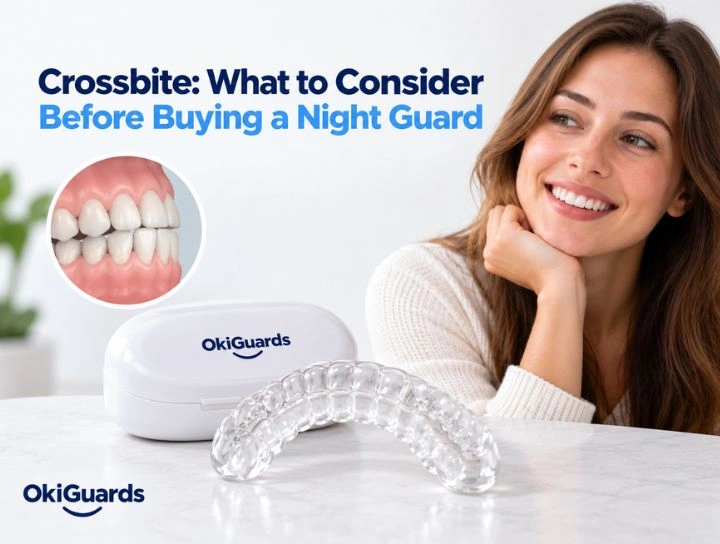
A person with a crossbite should receive a dentist or orthodontist’s fit guidance before buying a night guard, because the appliance must accommodate the existing bite while providing comfortable protection from grinding and clenching. Crossbite correction comes from personalized dental or orthodontic treatment, while a custom night guard serves as a protective appliance for teeth affected by bruxism. A crossbite changes how selected upper and lower teeth meet. This makes accurate impressions, upper-or-lower placement, material, thickness, and professional guidance especially important when choosing a custom night guard. Once a dental professional confirms that a custom guard suits the current treatment stage, OkiGuards offers Soft, Hybrid, and Hard options for different grinding levels. Each order includes two custom appliances created from the customer’s impressions.
Crossbite and Night Guard Overview
| Consideration | What it means | Positive next step |
| Crossbite type | Front or back teeth meet in a reversed relationship | Ask a dentist to identify the exact type |
| Grinding level | Grinding may be mild, moderate, or heavy | Match the material to grinding intensity |
| Upper or lower placement | Either arch may provide protection | Follow personalized fit guidance |
| Thickness | Changes the profile and amount of material | Choose the dentist-supported thickness |
| Active correction | Teeth may be moving through orthodontic care | Coordinate the impression timing |
| Dental restorations | Crowns, fillings, or other work affect the fit | Use a current and accurate impression |
| Fit monitoring | Bite relationships deserve continued observation | Bring the guard to dental appointments |
What Is a Crossbite?
A crossbite is a bite relationship in which one or more upper teeth sit inside the corresponding lower teeth when the mouth closes. A balanced bite usually places the upper teeth slightly outside the lower teeth. A crossbite can involve a single tooth, several teeth, one side of the dental arch, or both sides. It may develop from tooth position, jaw development, dental arch width, family traits, or childhood oral habits. A dentist or orthodontist can identify the type of crossbite by examining tooth contact, jaw position, facial balance, and dental development. This assessment creates a clear foundation for crossbite treatment and protective care.
Anterior Crossbite
An anterior crossbite affects the front teeth. One or more lower front teeth sit in front of the corresponding upper front teeth when the bite closes. Some anterior crossbites involve tooth position, while others relate more closely to the upper and lower jaw relationship. A professional evaluation helps distinguish between these patterns and guides treatment planning.
An anterior crossbite assessment may include:
- The number of front teeth involved
- Upper and lower jaw position
- Available space in the dental arches
- Tooth angulation
- Enamel contact
- Gum health
- Current grinding or clenching signs
A custom night guard can protect front teeth from grinding contact when a dental professional approves the design and placement. A current impression allows the appliance to follow the existing dental arrangement.
Posterior Crossbite
A posterior crossbite affects premolars or molars. The upper back teeth sit inside the corresponding lower teeth on one or both sides. A unilateral posterior crossbite appears on one side, while a bilateral posterior crossbite involves both sides. The dentist or orthodontist can also determine whether the pattern relates primarily to tooth position, arch width, or jaw development. Because back teeth carry substantial chewing and clenching forces, a posterior crossbite deserves careful night guard planning. The appliance should fit the current tooth contours and provide an appropriate contact surface.
Professional input can help determine:
- Whether an upper or lower guard provides the best fit
- Which material supports the grinding level
- Which thickness complements the bite
- When to take impressions
- How frequently the fit should be reviewed
How to Fix a Crossbite
Crossbite correction is personalized according to age, tooth position, jaw development, bite pattern, and the number of teeth involved. A dentist or orthodontist may use one or more of the following approaches.
Braces
Braces apply carefully planned forces to guide teeth toward improved positions. They can address anterior and posterior crossbites as part of a broader orthodontic plan.
Clear aligners
Clear aligners can guide selected dental crossbites through a sequence of customized trays. Each set supports gradual tooth movement according to the treatment plan.
Palatal expansion
A palatal expander can create additional width in the upper dental arch. This approach is commonly considered when arch width contributes to a posterior crossbite, particularly during suitable stages of growth.
Orthodontic elastics
Elastics can support planned movement between the upper and lower arches. An orthodontist provides specific attachment points and a wearing schedule.
Restorative dental care
Selected adult cases may benefit from bonding, onlays, crowns, or other restorative techniques when tooth shape and structure form part of the treatment plan.
Coordinated jaw treatment
A pronounced skeletal crossbite can receive coordinated orthodontic and surgical evaluation. This comprehensive planning supports alignment, bite function, and facial balance. A night guard has a complementary role in this process. It protects against grinding pressure while the dentist or orthodontist manages crossbite correction.
Can You Wear a Night Guard with a Crossbite?
Many people with a crossbite can wear a custom night guard when their dentist confirms the appropriate design. The guard should reflect the existing bite, tooth arrangement, restorations, and treatment stage.
A custom appliance provides several useful advantages:
- It is created from the individual dental impression.
- It follows the current tooth contours.
- It can fit over the selected dental arch.
- It creates a protective surface between the teeth.
- It supports enamel and dental restorations.
- It can be selected according to grinding intensity.
The most successful buying process begins with a professional crossbite evaluation. The dentist can confirm whether the upper or lower arch offers the preferred placement and whether the bite is ready for a stable custom appliance.
Crossbite Treatment Stage Matters
The timing of an impression can influence the long-term fit of a custom guard.
Before orthodontic correction
A dentist can evaluate whether a temporary or current-stage appliance would be useful while the crossbite treatment plan is being prepared.
During braces or aligner treatment
Orthodontic treatment gradually changes tooth position. The orthodontist can recommend compatible protection and determine when a new impression offers the most value.
After crossbite correction
Once the teeth and bite reach their planned positions, a fresh impression captures the updated dental arrangement. This can provide an ideal foundation for a personalized night guard when grinding protection is recommended.
After restorative treatment
Bonding, crowns, fillings, onlays, or other dental work can change tooth contours. Taking the impression after treatment allows the custom guard to reflect the completed restoration.
Seven Features to Check Before Buying
1. Professional approval
Begin with a dental or orthodontic evaluation. This confirms the type of crossbite, treatment stage, grinding level, and suitability of a custom protective appliance.
2. Impression-based customization
Choose a night guard created from your dental impression. OkiGuards provides three tray sizes, two sets of impression putty, written instructions, and access to an instructional video.
3. Upper or lower placement
The crossbite pattern may make one arch more suitable than the other. OkiGuards allows customers to choose two upper guards, two lower guards, or one upper and one lower.
4. Appropriate material
Soft, Hybrid, and Hard Night Guards provide different combinations of flexibility, comfort, and durability. Match the material with the intensity of grinding and professional recommendations.
5. Suitable thickness
Thickness influences the profile and grinding surface. A dentist can help determine whether a slimmer or more substantial appliance complements the existing bite.
6. Fit support
Responsive support adds confidence during tray selection, impression taking, and adaptation to the finished appliance.
7. A clear guarantee
OkiGuards provides a 60-night replacement and refund policy. Reviewing the policy before ordering helps customers understand the available fit and order support.
Choosing an OkiGuards Night Guard
| OkiGuards product | Price | Thickness | Intended grinding level | Product |
| Soft Night Guard | $149 for two | 2 mm | Mild grinding and clenching | View Soft Night Guard |
| Hybrid Night Guard | $149 for two | 1, 2, or 3 mm | Mild to heavy grinding | View Hybrid Night Guard |
| Hard Night Guard | $169 for two | 1.5 or 3 mm | Heavy or severe grinding | View Hard Night Guard |
Soft Night Guard for mild grinding
The OkiGuards Soft Night Guard provides flexible, cushioned material in a 2 mm thickness. It is designed for mild grinders, clenchers, first-time wearers, and comfort-focused customers. Professional approval can confirm that the flexible design complements the individual crossbite and current dental plan.
Hybrid Night Guard for balanced protection
The OkiGuards Hybrid Night Guard combines a soft inner layer with a durable outer surface. Its construction provides comfort around the teeth and a firm surface for grinding contact.
Customers can choose:
- 1 mm for a low-profile feel
- 2 mm for balanced comfort and durability
- 3 mm for additional grinding material
A dentist can help identify which thickness suits the crossbite relationship and grinding intensity.
Hard Night Guard for heavy grinding
The OkiGuards Hard Night Guard provides a firm and stable surface for heavy grinding and strong clenching. It is available in 1.5 and 3 mm thicknesses. Customers with a pronounced crossbite, extensive restorations, or a complex bite can include their dental professional’s recommendations when selecting this option.
What Comes with an OkiGuards Order?
Each standard order includes:
- Two custom night guards
- Three impression-tray sizes
- Two sets of impression putty
- Step-by-step instructions
- Access to an impression video
- A prepaid return mailer
- Custom laboratory fabrication
- Free standard shipping within the continental United States
- A 60-night replacement and refund policy
The second appliance provides a convenient custom spare. The OkiGuards How It Works page explains every stage from taking impressions to receiving the finished guards.
How to Check the Fit
A well-fitting guard should seat securely and feel comfortable around the teeth. People with a crossbite can pay special attention to how the appliance relates to their natural closing pattern.
A positive fit review includes:
- Secure seating
- Comfortable edges
- Consistent coverage
- Natural tongue space
- Stable placement during sleep
- Comfortable morning removal
- A familiar bite after removal
Bring the guard to routine dental appointments so the dentist can evaluate its condition, fit, and relationship with the bite. Dental guidance is especially valuable whenever orthodontic treatment or restorative care changes tooth position.
Caring for Your Custom Night Guard
A simple care routine supports freshness, comfort, and appliance longevity:
- Rinse the guard with cool water after use.
- Clean it gently with mild soap and a soft brush.
- Allow it to dry completely.
- Store it in a ventilated case.
- Keep it in a cool and secure location.
- Inspect the surface and fit regularly.
- Take it to dental appointments for review.
A fresh impression can provide an updated fit after meaningful orthodontic movement or restorative treatment.
Frequently Asked Questions
What is a crossbite?
A crossbite is a bite relationship in which one or more upper teeth sit inside the corresponding lower teeth when the mouth closes.
Can a night guard correct a crossbite?
Crossbite correction comes from personalized orthodontic or restorative treatment. A custom night guard provides complementary protection from grinding and clenching.
Can I buy a night guard online with a crossbite?
Yes, after a dentist or orthodontist confirms the appropriate placement, material, thickness, and timing for your current bite.
Is an upper or lower guard better for a crossbite?
The preferred arch depends on the location and type of crossbite, tooth anatomy, restorations, grinding pattern, and professional recommendation.
Which OkiGuards option suits heavy grinding?
The OkiGuards Hard Night Guard is designed for heavy or severe grinding, while the Hybrid Night Guard offers a comfortable dual-layer alternative in thicknesses up to 3 mm.

Final note
A crossbite involves a unique relationship between selected upper and lower teeth. Anterior crossbite affects the front teeth, while posterior crossbite involves the premolars or molars. Braces, aligners, expanders, elastics, restorative care, and coordinated jaw treatment can support crossbite correction according to the individual diagnosis. A custom night guard then serves a separate and complementary role by protecting teeth from grinding and clenching pressure. The best purchasing path begins with professional guidance about timing, placement, material, and thickness. Once approved, OkiGuards provides Soft, Hybrid, and Hard options made from the customer’s impressions. Every standard order includes two custom guards, complete impression supplies, free standard shipping within the continental United States, and a 60-night policy. Customers can shop OkiGuards Custom Night Guards after confirming the appropriate design with their dentist or orthodontist.